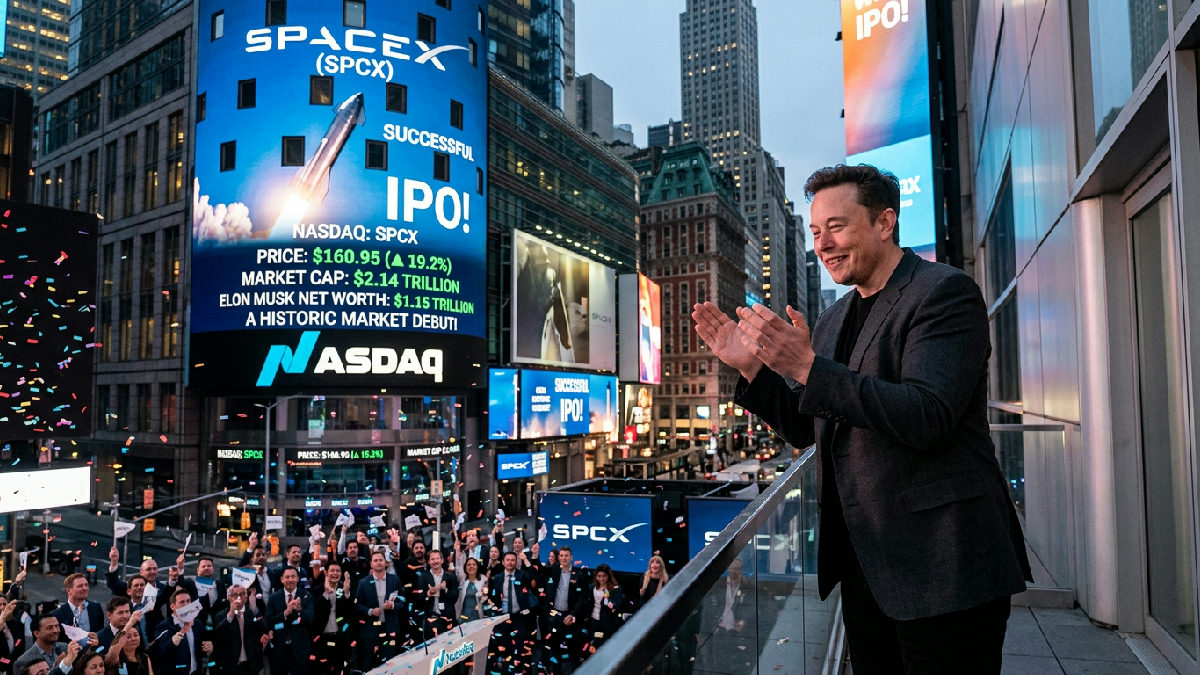
«What really happens doesn't worry me, as long as it looks good on paper»
Musk became the first trillionaire on the SpaceX IPO. I break down the company's fundamentals, why the market paid around two trillion, and how the listing actually hit the exchange — while everyone watched the fireworks.
Listen to article
On June 12, 2026, Elon Musk became the first person in history with a net worth above one trillion dollars. SpaceX listed on the Nasdaq under the ticker SPCX, priced at 135 dollars, closed its first day at 160.95 (+19%), and peaked near 222. A week and a half later the stock trades around 150 — down a third from the high.
While everyone watches the finger — the “first trillionaire” headline and the fireworks of the biggest IPO in history — the hands are doing the real work elsewhere: in index mechanics, in a low-float squeeze, and in the queue of OpenAI and Anthropic right behind. This article is about where the hands are. Let’s take it in order: where Musk’s wealth came from, what sits behind SpaceX’s valuation, how its IPO hit the market, and why this is only a rehearsal.
SPCX — first days of trading, $

Priced $135 · 1st-day close $161 (+19%) · peak ~$222 · pullback to ~$150
Musk’s wealth is a revaluation of stakes, not cash
Musk was never rich in cash. His net worth is the market revaluation of two holdings: roughly 41% of SpaceX and 20% of Tesla. These stakes are illiquid and don’t turn into cash without a sale, and every sale presses on the price and dilutes control. “A trillion” is a mark-to-market accounting figure, and it swings by hundreds of billions a week: after the peak Musk’s wealth briefly reached 1.4 trillion, and by June 21 it settled at 1.23.
Musk earned real cash exactly once, and long ago. Zip2 was sold to Compaq in 1999, netting him about 22 million after tax. X.com, merged into PayPal, went to eBay in 2002 for 1.5 billion, and his stake brought him roughly 180 million after tax. That is his entire starting cash capital. After that he didn’t accumulate, he invested: around 100 million into SpaceX and around 6.5 million into early Tesla. His net worth grew not from earnings but from those stakes revaluing thousands of times over.
The key point: until June 12 SpaceX was private, and its price rested on closed insider deals rather than the market. The IPO put a public price tag on the stake for the first time. What made Musk a trillionaire wasn’t new income but liquidity — the moment a paper stake got an exchange price.
SpaceX fundamentals: two different companies in one
SpaceX looks like a rocket company, but the internet is what makes it money. 2025 revenue was 18.7 billion versus 13.1 billion in 2024, up 43%. Inside sit two businesses with opposite economics.
Launch services is the original business: launches for NASA, the Pentagon, and commercial clients. In 2025 it brought in about 4 billion, grows slowly (around 8% a year), and runs into the physical ceiling on the number of launches.
Starlink — satellite internet — brought in 11.4 billion, that is 61% of all revenue, and grew 48%. By early 2026 the service had more than 10 million subscribers across 160+ countries. It’s a subscription with recurring revenue, and it is what generates profit: around 4.4 billion in operating profit for the year. The telecom arm makes all of the company’s profit, while the rockets remain the capital-heavy base that makes that telecom possible.
SpaceX revenue, $B

Starlink = 61% of 2025 revenue and the company's only operating-profit engine.
SpaceX’s competitive edge is economic, not engineering. Falcon’s reusability cut the cost of putting a kilogram into orbit by multiples relative to rivals. Cheap launch lets it put up its own Starlink satellites often and cheaply, while a competitor buying launches on the open market can’t make such a constellation pay off. A closed loop of its own rockets, own network, and own service is expensive and slow for rivals like Amazon Kuiper or OneWeb to replicate.
Yet on a GAAP basis the company is unprofitable: a net loss of 4.9 billion for 2025. Adjusted EBITDA is positive (6.6 billion), but it’s eaten by capex on the constellation and Starship, stock-based compensation, and losses from Musk’s affiliated assets (X and xAI) consolidated into the accounts. Operationally Starlink is already profitable, but the company as a whole is burning money building the future.
Why the market paid around two trillion — and where the hole is
At 18.7 billion in revenue, a valuation near two trillion means roughly 100 annual revenues. Mature telecom and aerospace trade at 2–5 revenues; fast-growing tech rarely goes past 20–30. SpaceX is priced as if it has already done what it only promises. Before the IPO itself, the valuation on closed deals was ballooning.
SpaceX valuation: private rounds → IPO

~6x in 18 months · IPO multiple ≈ 100x revenue.
Bluntly: at that multiple the market is paying not for today’s business but for three options — Starlink’s global dominance, Starship entering regular service, and defense contracts amid the militarization of space. If even one fires fully, the price tag will be justified in hindsight. If not, this is overpaying for a narrative, and the third lost in a week and a half shows the market has started to unwind it. The risks this price tag ignores: concentration (61% of revenue in one product, with Starlink ARPU already falling as it expands into poorer markets), regulatory pressure on orbital spectrum, the whole structure’s dependence on one person, and the share of “profitability” that rests on non-cash adjustments.
Here are the hands: how the IPO hit the market
The listing pulled more than 75 billion out of the market in a few days — the biggest IPO in history. The money didn’t appear from nowhere; it was shifted out of other positions: retail bought SPCX with net buying 3.5 times higher than NVDA. The space sector itself fell hardest, because funds and traders cut adjacent names to crowd into the headline event. This is a classic siphon — a giant draining liquidity from its sector neighbors.
Space stocks on SpaceX IPO day, %

Capital siphon: managers sold the sector to fund the headline IPO.
But the most systemic effect is index mechanics. Effective May 1, 2026, the Nasdaq changed its methodology: a company in the top 40 by market cap enters the Nasdaq-100 after just 15 trading days, and the minimum free-float requirement was scrapped entirely. SpaceX, at a trillion-dollar cap, enters the index almost immediately — even though only 3–5% of its shares are in free float. Passive funds (QQQ, Russell 1000 funds) must hold the stock at its index weight, and to buy it they’re forced to sell Apple, Microsoft, Nvidia, and every other constituent proportionally. The arrival of a single stock mechanically presses on the index’s current leaders with no connection to their own fundamentals.
Combine that with the 3–5% float: forced demand from index funds runs into almost no supply, and the price is set by imbalance rather than revenue. Hence the jump to 222 — a structural squeeze, not a revaluation of the business. The flip side is already coming: SpaceX has a staggered 180-day lock-up, and the unlock schedule (first 20% after Q2 earnings, tranches on days 70–135, another 28% after Q3, full unlock in December) will add supply exactly as the initial frenzy fades. Musk and major investors are locked harder — 366 days, until June 13, 2027. The pullback to 150 is the start of that turn.
Why SpaceX is only a rehearsal
This is where it gets interesting. SpaceX is just the first of three private giants of roughly a trillion each, going public within one year.
OpenAI filed confidentially with the SEC on June 8, 2026, aiming for a fall listing, but given its non-profit → PBC conversion late 2026 to early 2027 is more realistic. Its latest valuation is 852 billion (a 122-billion round led by Amazon, Nvidia, SoftBank, and a16z). Run-rate revenue is around 24 billion a year. The company is deeply unprofitable: roughly 14 billion in losses in 2026 alone, with profitability not expected before 2030.
Anthropic also filed confidentially, around June 1, 2026, and may go public as early as October, leapfrogging OpenAI. Its Series H round was 65 billion at a 965-billion valuation, topping OpenAI for the first time. Per the round itself, run-rate revenue crossed 47 billion, and the company expects its first operating profit (I treat that figure with more caution — it comes from the round’s press materials, not an audit).
Price / sales multiple, x

Market reference multiples compared with AI and SpaceX.
On multiples the picture is this: OpenAI around 35 revenues, Anthropic around 20. That’s “cheaper” than SpaceX’s space-grade insanity, but on a far more loss-making base. When those two follow, the effects from the SpaceX case won’t just repeat — they’ll stack and add a new one. A series of mega-IPOs competes for the same pool of capital, and the fact that SPCX is already down a third from its peak says the pool isn’t bottomless.
Hence the main risk that SpaceX didn’t have. A loop has formed: OpenAI and Anthropic raise money from Nvidia, Amazon, and Microsoft, spend it on those same companies’ chips and cloud, whose revenue and market cap then rise, which funds new investment into AI startups. While the money was private, the loop spun inside a narrow circle. The IPO lets retail and passive index money into it. On the way up the structure self-reinforces; on a sentiment reversal it unwinds in both directions at once — the startup falls and so does its supplier-investor, because they hold each other’s risk.
The systemic takeaway is simple. The S&P 500 and Nasdaq-100 are already overloaded with a handful of AI-linked mega-caps. Add SpaceX, OpenAI, and Anthropic at a trillion each, all tied to the same AI-capex cycle, all inside passive funds — and the “diversified” index becomes a leveraged bet on a single scenario: that AI spending pays off on schedule. Every QQQ holder now owns that bet without choosing it.
The skeptic’s voice: what Burry is betting on
Michael Burry, the one from “The Big Short,” has already put money on this cycle. To be precise: he isn’t shorting “the market” broadly but AI specifically, and his strong argument is an accounting one, not a mood.
Through Scion, around 80% of the portfolio is put options on Nvidia and Palantir, roughly 1.1 billion notional, a position he doubled since the third quarter of 2025. His thesis: the hyperscalers (Meta, Amazon, Microsoft, Google, Oracle) depreciate Nvidia GPUs over 5–6 years, while a chip’s real economic life is 2–3 years, because a new generation arrives every 18–24 months and devalues the old one. By his math that means 176 billion of under-recorded depreciation over 2026–2028 and overstates profit by an average of 24%, and at Oracle by 48–62%. He put the dot-com analogy this way: “there’s a Cisco at the center of all this, and its name is Nvidia.”
But his scorecard is mixed, and that has to be said honestly. Palantir fell from 200 to 132 (down 34%) since the end of Q3 2025 — here he’s right. Nvidia in May 2026 hovered near 215, close to its all-time high, and his 110-strike puts are deep out of the money and well underwater — here he’s wrong so far. A thesis can be right on substance and loss-making on execution: he bought a date, and options expire. That’s his own lesson from 2005–2007, when he entered the mortgage short too early and sat in drawdown for two years. I treat Burry himself with restraint as a timing indicator — after 2008 he had plenty of premature and wrong bear calls, plus he wound down Scion as an outside-money fund and moved to a paid Substack, meaning he now monetizes the bearish narrative directly.
So the market’s real test is ahead, and it has concrete dates: the SpaceX unlocks from July to December, the OpenAI and Anthropic listings that same fall, and the hyperscalers’ earnings, where Burry’s depreciation math will either be confirmed or refuted. The market already gave its first signal — SPCX gave back a third of its run in a week and a half. Watch the hands, not the finger.
© Seal