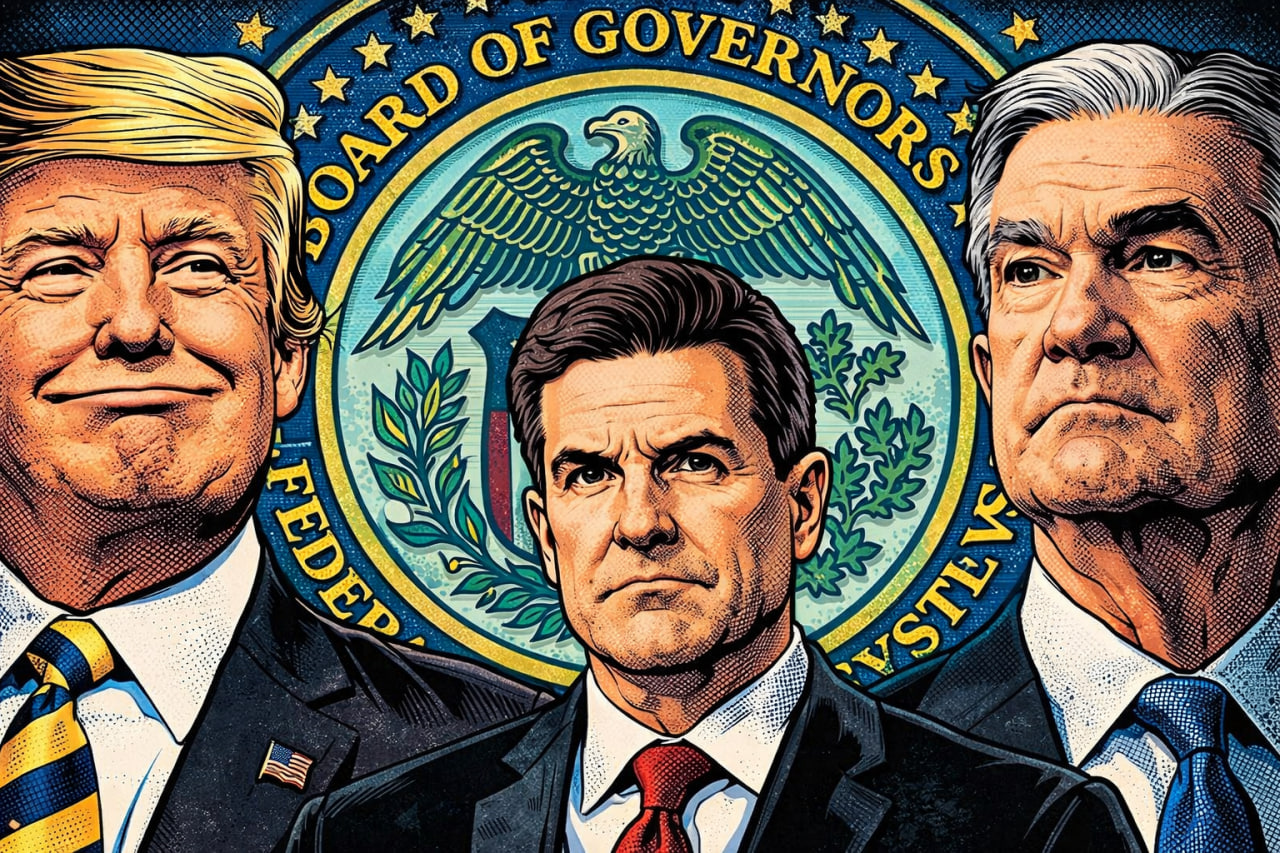
The End of the "Good Afternoon" Era
Trump fired Powell as Fed Chair. Breaking down what it means, whether there are precedents, and who replaced him.
Listen to article
I completely dropped off this month — finals season. But starting Monday, we’re back to full operation. While I was away, a lot of interesting things happened in the US economy. But probably the most important: the Fed held rates in the 3.50%–3.75% range, and the very next day Trump declared a national emergency and removed Jerome Powell as Fed Chair.
I can only assume the aspirin stopped thinning his blood, causing a clot that cut off blood flow to his brain — I have no other explanation…
The core issue is that the US president does not have the authority to appoint Federal Reserve chairs unilaterally. That requires Senate approval. However, Trump declared a national emergency “due to a threat from Cuba,” which effectively allows him to act unilaterally on virtually any decision.
But there is precedent in US history for a president removing a Fed Chair — read more
For example, in 1987 my beloved Ronald Reagan did just that with Paul Volcker.
In the 1980s, the US was dealing with high inflation, particularly in the early part of the decade. Paul Volcker, appointed Fed Chair in 1979, adopted a strict monetary policy aimed at fighting inflation. He raised interest rates significantly, which drove up borrowing costs. But it also led to a sharp contraction in economic activity in the short term and a recession in the early 1980s.
Volcker continued his tight policy into the mid-1980s, creating political tension. High interest rates angered business, politicians, and consumers alike.
Ronald Reagan came to power in 1981 with his “Reaganomics” program — tax cuts, deregulation, growth stimulation. He sought paths to faster growth, which he believed the Fed’s tight policy was impeding.
By 1987, inflation had been brought down, but the economy was still suffering from high rates. In this environment, Reagan decided Volcker was no longer the right chairman for his economic agenda.
Most businessmen and bankers were unhappy with Volcker’s policy, believing it was holding back growth. This put pressure on the Reagan administration.
After Volcker’s departure, Reagan appointed Alan Greenspan. His more flexible approach allowed Reagan to continue his growth stimulation program without abandoning inflation control goals.
Who Replaced Powell
The new Federal Reserve Chair is Kevin Warsh — an American financier and lawyer, former member of the Fed’s Board of Governors (2006–2011), and former adviser to President George W. Bush.
Warsh rarely makes public statements on the economy, but advocates for rethinking the Fed’s role — including shrinking its balance sheet and reducing “creative” tools like QE.
He is historically known as a hawk on monetary policy. His statements suggest the Fed should be more independent and strategic, rather than bending to short-term political demands.
Despite his good relationship with Donnie, many experts note that Warsh has his own views and even if appointed by Trump — may not fully follow the White House’s wishes, instead relying on economic logic. It’s hard to say what his path will look like right now, but I’ll be watching.
Do I Support the Fed Chair Change?
A contentious question. On one hand — replacing him with a young and promising economist is a serious move. On the other — Grandpa Powell deserves a statue for preventing a default in the 2020s at the peak of Sleepy Joe’s “wonderful” policies.
Overall, the rightward shift in US economic policy can only be welcomed. The main thing is for the Fed to remain independent from whoever’s in power. Still worth acknowledging: a carrot makes about as good an economist as I do a ballerina — and it’s far from certain I’d be a worse ballerina…
In fairness — it’s disappointing that the very person who nominated Powell to this role in 2018 is now removing him so brazenly. Trump doesn’t tolerate disloyal people, and that’s what concerns me most.
Thank you for reading. Have a great weekend and a productive February ☕️
© Seal