Argentina: Milei's Stabilization and the Cost of Recovery
What happened to Argentina's economy after Javier Milei took office: inflation, the budget, the currency market, trade, labor, and the social cost of reform.
Listen to article
Javier Milei took office on December 10, 2023, with annual inflation at 211.4%, a chronic budget deficit, strict currency controls, and almost no confidence in the peso. In less than three years, his government changed the direction of the economy: inflation slowed, the national public sector moved into financial surplus, and growth resumed after recession.
The recovery is uneven. Exports, agriculture, energy, and mining are doing better than domestic consumption and parts of manufacturing. Poverty has fallen from its 2024 peak, but the labor market remains weak. Foreign-exchange reserves are still too thin to declare the risk of another crisis over.
The figures below use the latest data available on August 25, 2026.
Inflation slowed; prices did not fall
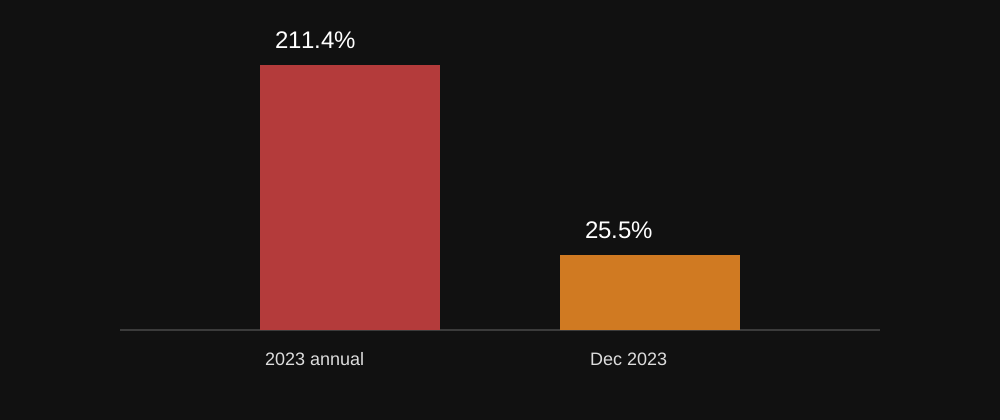
Consumer prices rose 25.5% in December 2023 alone. By July 2026, monthly inflation had fallen to 2.1%. Prices were 33.8% higher than a year earlier and 19.3% higher than in December 2025.
This is the clearest result of Milei’s program. The government cut the deficit, stopped direct monetary financing of the Treasury, and removed some price and currency distortions. It also cut public spending and subsidies.
Slower inflation does not mean cheaper goods. Prices still rise, only more slowly. Tariffs and services have continued to rise faster than parts of the consumer basket.
Source: INDEC — consumer prices.
The budget became the program’s anchor
The fiscal break came in 2024. The national public sector ended that year with a primary surplus of 1.8% of GDP and a financial surplus of 0.3%.
A primary surplus means revenue exceeds spending before interest payments. A financial surplus includes interest: the government still has money left after ordinary spending and debt service.
In 2025, the primary surplus was 1.4% of GDP and the financial surplus about 0.2%. Argentina had previously relied on new debt, money creation, or both to cover its deficits.
The cost is visible: subsidies, transfers to provinces, and public investment were cut. A positive balance does not make debt safe by itself. Interest rates, the currency of the debt, maturities, and access to refinancing still matter.
Sources: 2024 results and 2025 results.
LELIQ, interest rates, and credit
Before the reforms, the Central Bank used LELIQ (Letras de Liquidez, short-term interest-bearing papers available to banks) to absorb excess pesos. Banks placed money in LELIQ and received interest.
The stock of these instruments and the interest bill grew. The mechanism could feed itself: the bank absorbed pesos already issued, then created new liabilities to pay interest.
In December 2023, the BCRA stopped new LELIQ auctions. The last instruments matured in January 2024. Banks then shifted much of the money into one-day reverse repos, where they temporarily place funds at the Central Bank for interest.
In July 2024, reverse repos were also closed. They were replaced by LEFI (Letras Fiscales de Liquidez, Treasury bills used to manage bank liquidity). The interest cost moved from the Central Bank’s balance sheet to the Treasury. The debt did not disappear; the debtor and the instrument changed.
The policy rate is the benchmark used by the Central Bank to influence borrowing and deposit returns. It was 100% TNA in December 2023 and 32% at the end of 2024. TNA is the nominal annual rate before intra-year compounding.
Source: BCRA — monetary policy and LELIQ.
Recession ended, growth remains uneven
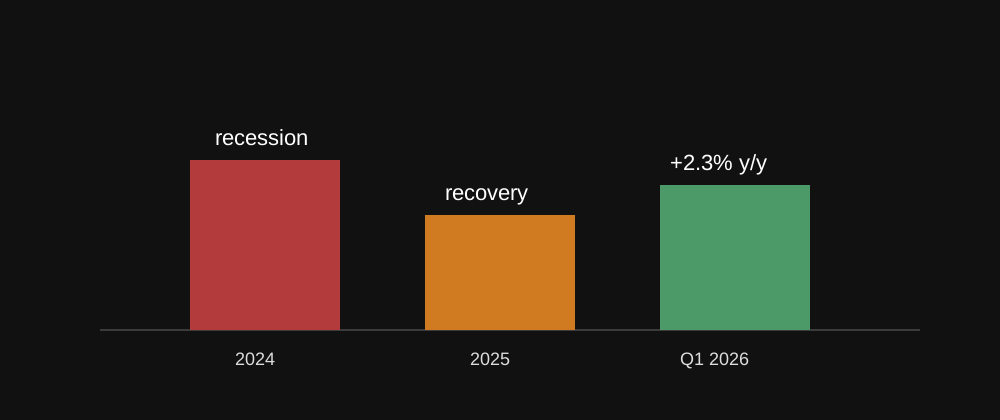
GDP fell 1.3% in 2024. The economy was already weakening before Milei took office, and spending cuts and falling real incomes made the contraction worse.
GDP grew 4.4% in 2025. In the first quarter of 2026 it rose 2.3% from a year earlier and 0.7% from the previous quarter after seasonal adjustment.
Seasonal adjustment removes regular calendar effects such as holidays, harvest cycles, and different numbers of working days. Exports rose 9.8% year on year in the first quarter, while manufacturing fell 1.7%. Supermarket sales at constant prices were 3.1% lower in June than a year earlier.
Argentina is out of recession, but consumer recovery is lagging behind export industries.
Source: INDEC — national accounts.
The dollar is freer; the currency problem remains
The government sharply devalued the official exchange rate in December 2023. On April 11, 2025, the Central Bank introduced exchange-rate bands: a defined range within which the price moves with supply and demand.
Since January 2026, the band limits have been adjusted using the latest available monthly inflation figure. The gap between official and parallel rates narrowed, but Argentina still has several dollar prices. MEP uses local securities trades, CCL allows dollars to be moved abroad, and the parallel rate reflects the informal cash market.
Net reserves are the Central Bank’s foreign-currency assets minus its foreign-currency liabilities. Argentina missed the IMF target for net reserve accumulation at the end of 2025. In May 2026, the IMF approved an immediate disbursement of about $1 billion. The EFF (Extended Fund Facility, long-term IMF financing linked to reforms) was approved in April 2025 for roughly $20 billion.
IMF money buys time. It does not replace Argentina’s own reserves or normal market access.
Sources: BCRA — exchange-rate bands and IMF — second review.
Trade and investment
In July 2026, exports reached $8.85 billion and imports $6.74 billion, leaving a $2.12 billion surplus. The January–July surplus was $16.08 billion.
Agricultural commodities and processed products remain the base of exports. Oil and gas from Vaca Muerta and lithium are becoming more important. In 2024, the surplus also reflected the recovery from drought and a recession-driven collapse in imports. In the first seven months of 2026, exports rose 22.9% year on year while imports fell 3.5%.
Ley de Bases No. 27.742 created RIGI (Régimen de Incentivo para Grandes Inversiones, an incentive regime for large investments). It gives major projects more predictable tax and currency rules, including in energy, mining, and infrastructure.
That helps capital-intensive projects, but does not solve the wider investment problem. Investors still price court reliability, tax rules, access to dollars, and the risk of a policy reversal.
Sources: INDEC — foreign trade and Ley 27.742 and RIGI.
The social cost rose first, then began to fall
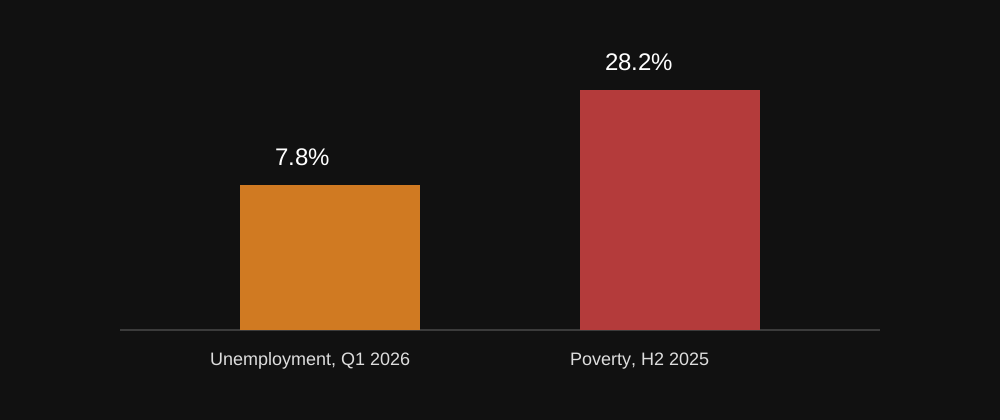
In the first half of 2024, poverty reached 52.9% of people in the 31 urban agglomerations measured by INDEC; extreme poverty reached 18.1%. In the second half of 2025, those figures fell to 28.2% and 6.3%.
The data cover urban agglomerations, not the whole country. A fall from the peak does not erase the income losses families suffered at the start of the reforms.
In the first quarter of 2026, unemployment was 7.8%, employment 44.8%, and labor-force participation 48.6%. Participation measures people who work or actively seek work, so a lower unemployment rate alone does not prove a healthy labor market.
In May 2026, the nominal wage index rose 35.9% year on year while CPI rose 33.2% over the same period. Nominal growth is the peso amount; real growth is purchasing power after inflation.
Sources: INDEC — poverty, labor market, and wage index.
Political room to maneuver expanded
In the October 26, 2025 midterm elections, La Libertad Avanza strengthened its position in Congress. The preliminary official distribution gave it 95 of 257 seats in the Chamber of Deputies and 19 of 72 in the Senate.
That is not a majority. The government still needs allies, governors, and regional blocs. It is nevertheless in a better position to build coalitions than it was at the start of the presidential term.
Source: Argentina’s National Electoral Directorate.
Is Milei doing everything right?
My answer is that the direction is broadly right. Argentina could not keep financing deficits with money creation, maintain several incompatible exchange rates, and postpone price corrections indefinitely. Milei addressed those problems and produced measurable results.
Deficits and money creation were not the only causes of Argentina’s crises. Weak institutions, a difficult debt history, commodity dependence, and distrust of the peso remain. Spending cuts alone cannot solve them.
I consider the direction right, but without stronger real incomes and reserves, the current stabilization will remain temporary.
© Seal